
To consume a book to the eyes through the brain, to read the words on the page, they are broken up into chapter sections.
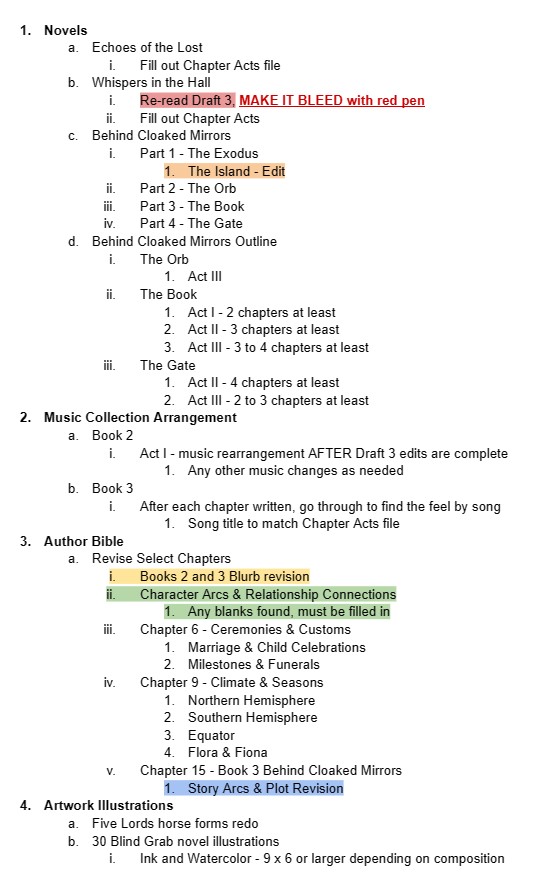
To write the book, it is broken down even further for easy study for said project. I’ve discovered over the last eight years that I may have overdone the ‘broken down projects’ by creating too many. Yet, each side study project of these manuscripts is vital for me to fully understand the story. So, I can find scene sections that need to be reworked or completely removed. To understand the world in which I’ve created to the deepest depths of its culture. If I can’t understand the Geraci family or the world of Mythia, then how can any reader understand it?
The problem is, each time I study the material, I make a WHOLE new file for said study time. I just realized how many odd study files I’ve created for myself to over analyze. It’s the bane of a type A personality, I’d say.
There’s the typical, or I hope typical, Author Bible that houses the following:
- Character Profiles – Personality Traits, Backstory Histories, Family and Character dynamic interactions, Character Plot Arcs, Character Photos and Character Artwork
- World Building – Culture, History, Flora/Fauna, Governmental Laws, Historical Events, Important Character Figures, Foods, Monuments, Natural Landmarks, Geography, Astronomy
- Sciences – Hair Colors, Eye Colors, Height, Family Genetics, Evolutionary Changes, Diet, Birth Rates, Psychological Changes
- Gods and Religion – Ceremonial Practices, Deity Histories, Religious Practices, Sacred Locations, Temples, Holy Books, Artifacts/Relics, Magic System
- Plot – One Liners, Premise, Blurb, Synopsis 1 page, Synopsis 2 pages, Synopsis 3 pages, Scene Blurbs, Story Outline, Query Letter
- Story Timeline – History Timeline, Character Timeline, Critical Story Events Timeline
- Journal Cataloging – Calander, Hours Worked, Word Counts Made, Odd Notes, Rewriting Story Notes, Story Notes in Craniological Story Order Re-Journaled for easy access.
But then, I will take one of these above files, say for example Religious Practices, the whole breakdown of the Noukadian Temple Priesthood from its critical events for the story, down to when and how the Temple was built. I’ll go back to this file and add more to it that I spotted in my Story Outline.
Then this leads to going through the Story Outline again to discover a chapter needs to be reworked or removed completely. Then, I come across a story analysis excises that makes me break down the chapters into their proper story beats (learning not all Story Beats will be used, that’s normal and okay). Which further helps me find mistakes in chapters that have yet to be fully written. Furthermore, makes me go back to the Author Bible to revise an area to make sure it is correct and can be followed. If there is one element from the Author Bible that effects the Story Outline to be misaligned, then I cannot effectively write the story as it deserves to be told.
Yes, this means the odd project break downs keep happening. The Story Beat breakdown is what I’m working on as of last night. Because of this question check list, it helped me find a chapter/character development that is misplaced in the timeline of the story. Each piece I work connects the story’s progress to be that much better.
This whole process may look like it’s taking too long, but in the long run it is vitally helpful to create a better story. In the end, I hope this story is free of scene, character, plot issues. I know no book is perfect, but Quality Control is desperately needed in all new books as they come into the world by their creative authors. If we don’t do the work, then who will if they aren’t there to help us make better products that people love to consume and hopefully read and read again for years to come.
Writing a novel or a non-fiction takes time. These are processes that should never be rushed. The dedication and love for detail will pay off in the end for the author, editors, publisher and finally, the audience, the reader. The readers deserve quality and that’s why I do these multiple mini analysis breakdown projects. I do the hardest work for the future of my readers because I believe in this book, and you deserve the best I can give.



 Tara B. Dobbs